Monday, February 15, 2016
JNU : freedom too has limits
Monday, July 06, 2015
Vyapam Case: Statistically Probable?
One mystifying aspect of the scam is that approximately 35-40 deaths have been reported of people involved with the scam , after it got reported and investigation started. The deaths involve witnesses and accused lodged in various jails. As per Wikipedia entry, I could count 33 people have died, starting from November 2009.
https://en.wikipedia.org/wiki/Vyapam_scam
Since the number of people under investigation in the scam is sufficiently large ( reported to be more than two thousand), it is a fit case where statistical analysis can be applied with reasonable accuracy to see if 40 deaths are likely in a set of randomly selected 2000 individuals over a period of 5 years.
So first we need to know the probability of a person aged X, dying within a year. This is given by the 8 year rule, where the probability of any individual dying the same year increases by twice every eight years. The actual probability varies across populations but the 8-year doubling is universal. Here is a good article that explains the idea.
Am I Going To Die This Year? A Mathematical Puzzle
Since probability of dying or "mortality rate" is very important for life insurance companies, standardized tables exist for different countries. The official table for India as published by IRDA is given hereIndian Assured Lives Mortality
Assuming that the 2000 accused and witness are evenly distributed across age-groups of 21 to 61, I divided the whole age span into 5 categories of 8 years each. Each of the categories I approximated with median age and took mortality figure from the actuarial table given above. Doing the calculation of number of deaths expected for 5 years from among 2000 randomly chosen individuals comes out to be 35 as shown in table below.
![]() |
| Expected Mortality for 2000 individuals across 5 years |
So the total deaths expected in any randomly selected set of 2000 individuals across a span of 5 years is approximately 35 in India. This is assuming that their ages are evenly spread between of 21 and 61, which is a reasonable assumption since those who are too young and also those who are too old can be safely excluded from being "linked" to the scam.
Conclusion:
The only limited conclusion we can d is the number of deaths are pretty close to expected. There may still be some foul play at work and some of those people who died may have been murdered etc, but those would be to be a small fraction of the 35-40 dead in past 5 years. Hence, we cannot infer a conspiracy just from the number of dead as our prime-time media circus seems to be implying. In fact if fewer (say 5) or many more (say 60) of the accused were dead within past 5 years, it would have been an obvious statistical anomaly.
There of-course leaves the problem of high proportion of claimed accidental deaths (road-accidents etc) which also looks suspicious. That is also worth looking into ...
Sunday, April 13, 2014
Why Right is Right for India, economically and socially
Free market capitalism is the only economic philosophy which has been empirically proven time and again to succeed in improving the economic well-being and quality of life of pre-industrial societies like India. As I have argued in one of my previous post on AAP, such an orientation is even more important for the poorer sections of society than the middle classes. Since spread of education is still limited in India in both quality and coverage, large scale investment in manufacturing and other low-skill labor intensive industry is the only sustainable way to create ample number of jobs and eradicate poverty. There is a broad consensus on this in most academic and policy research circles now, with minor variations in thrust and priority. There are of course is a pro-redistribution camp which pay lip-service to economic liberalism, and lends some confusion to the debate. This is best typified by the spat between the Columbia professors Panagariya/ Bhagwati on one hand and Amartya Sen/Dreze on other. The later pair however have little credibility now, having been contributors to Sonia's NAC over past ten years and hence indirectly responsible for the current economic mess. Panagariya/Bhagwati have argued growth vs redistribution argument very well in a series of books like India: The Emerging Giant and Why Growth Matters. Since the economic side of argument is well understood, let me move on to the social aspect of right.
India is an old civilization but a new republic. It is also on path to evolving into as modern and developed nation. For this it is imperative that people evolve a common sense of identity. This shared identity can only be based on something I like to call Indic culture. Despite the diversity, all Indians share a commonality of culture, ultimately derived from a long and shared history. This shared mythology, philosophy, language, values and culture provide a substratum on which such a common identity can be built. Though role of religion is often overstated by alarmists in this context, religious exclusivity of identities is not a feature of India traditions from ancient times, in a fashion very similar to other east asian cultures like Japan and China. Even the term hindutva, though considered as sectarian by some, is essentially defined by the supreme court judgement as all ideas, thoughts, philosophy and cultural habits that have evolved in the subcontinent. In olden days, besides the Dharmic faiths like Hinduism, Jainism, Sikhism, and Buddhism, Indian Muslims were also labelled as Hindus. So the debate here essentially more about nomenclature and semantics than anything else.
Monday, March 24, 2014
Direct Democracy: Snake Oil that sells well.
"Philosophy is a battle against the bewitchment of our intelligence by means of our language."
- Ludwig WittgensteinLet us first start by looking at the often confused concepts of "direct democracy" and somewhat related, though different concept, best called "local self-governance". Local self-governance implies the mode of administration and citizen feedback wherein local communities at village level or block level may be involved in decision making for issue of concern limited to the local community itself. I would circumscribe this concept further by limiting it to areas of administration for which a larger collaboration or impact beyond local-community may not been involved and direct visibility of the activities on ground would be available with the citizens. As a general principle, it is good to decentralize wherever possible, and with this circumscribed definition, I think local-self governance a good idea, which is already partially implemented in villages through Panchayats and in cities through RWA's, though exacts mechanism and workings can be further refined and improved.
On the other hand "direct democracy", especially in context of referendums, refers to the practice of taking the will and opinion of people by majority vote at a much larger scale of a country or a state and utilizing this for effective decision making. This has sometimes been resorted to for big decisions at national level e.g. referendum for separation of Quebec in Canada, but seldom for more regular policy decisions and with good reason.
"Democracy is the worst form of government, except for all those other forms that have been tried from time to time."
- Winston Churchill.Unlike how Indian politicians extol the virtues of democracy and the intelligence of the voter, let us take a considered view of whether democracy in terms of universal adult franchise is the best form of government and, if so, why. There is a view with some people that a benevolent and wise dictator or would be much more effective in ensuring the progress and well-being of a country than any democratic setup can be. Though partly true, this is a simplistic view of things which fails to consider issues of sustainability and feedback. Firstly, there may not be that many certifiably benevolent dictators graciously making themselves available to us. And even fewer among them could be guaranteed to stay benevolent after attaining despotic power which we plan to confer upon them. Secondly, and more importantly any dictator or council of dictators, would lack one key enabling function which makes democratically elected government the only form of government which has consistently succeeded in past century.This is the power of feedback. Feedback to those managing the institution of government from those on whose behalf the institution is managed, is by definition only available in an electoral democracy, and however slow or partial , it is essential for making any government effective.
India and most big democracies have chosen to have representative form of democracy which relies on electorally chosen leadership and not electoral decision making. The principles of representative democracy in Indian constitution and direct democracy are hence fundamentally different. Direct democracy expects people to have well formed opinion on a host of issues that are important in their daily lives. For each of these issue people's consent maybe asked for by direct polling, and based on majority view a particular course of action adopted. Since direction on any one issues is necessarily interlinked with direction on many others, people can tend to support mutually contradictory goals in different referendums, since they may often fail to realize the underlying interconnections. This was visible when people voted for free power in Delhi elections, while not considering how incorrect pricing has very adverse impact on availability of electricity as shown in over past several few decades. Likewise poeple would vote for lower taxes at the same time expecting more government spending and social safety nets.
On the other hand representative government expects a single person or party to evolve a coherent set of ideas and policies which taken together intend to fulfill the goal that the electorate has in mind. Since all policies are decided together by a set of specialists with a common ideological leaning, the policies are not expected to be self-contradictory. The policies proposed may or may not appear to fulfill the desired goals, but different parties can propose different set of strategies and compete for voter attention. The voter doesn't chose policies or plans a-la-carte but whole ideologies (coherent set of ideas) which best appeals to him. Even on issues of which he may not have sufficient knowledge, the voter may chose the ideas based on trustworthiness of individuals proposing them and their past record of success. Hence this manner of decision making not only leads to coherence in policy making, it also allows for the voter to entrust decision making for matters involving specialist knowledge he may not possess himself to the people he trusts. Also, any policies or principles involved in governance may require time to show results. Representative democracy gives adequate time for those policies to come to fruition and delays feedback sufficiently to make the feedback meaningful.
"Ultimately a genuine leader is not a searcher for consensus, but a molder of consensus."
- Martin Luther KingLastly, the idea of leadership in electoral democracy is not only about following public opinion but molding public opinion. The public is of-course free to get convinced or otherwise. A leader with no conviction of his own, except for following majority public opinion, is not a leader in true sense of the word. The progressive and reformist Hindu Code Bills would never have been passed if Nehru and Ambedkar had only cared for Public Opinion. Nor would the 1990s reforms by Narsimha Rao Government have taken place.
To conclude, the two contradictory requirements of close feedback and coherent policy and effective decision making need to be reconciled. Representative democracy is a balance between autocracy without feedback, and direct democracy without coherence and effectiveness. Asking for referendum for each and every policy decision can only lead to chaos, and is unlikely to gain credence despite any current or future technological enablers.
Tuesday, December 03, 2013
AAP aur Hum - Some thoughts
It is the season of politics here in Delhi, and I too was asked by a couple of kids for my views on AAP and Delhi elections. So let me have some fun and share my thoughts on the matter at hand through this post.
- “The love of the intellectual Indian for the village community is of course infinite, if not pathetic….What is a village but a sink of localism, a den of ignorance, narrow mindedness and communalism?” - BR Ambedkar
Whatever the ceaseless mythologizing of past we would like indulge in, grinding poverty has always been part of human condition for the majority of populace in all cultures in pre-industrial age. Industrial revolution starting in 1820s in England and a few decades later in United States and Germany, improved the means of production and pulled millions of subsistence farmers into middle-class workforce. In every country in past 200 years, Industrialization has followed the identical pattern of wealth creation and rapid urbanization, leaving only a small fraction of population employed in agriculture (whose lot has also improved). Over past few decades this has started happening at a rapid pace in China and other East asian countries as well. Whatever the virtue of Mr Kejriwals financial decentralization schemes and romanticism for village financial autonomy of the past, India would also have to follow the same path. With a disdain for sound economics , which Mr Kejriwal says is "irrelevant" to common man ("aam aadmi"), AAP may eventually put India into the same trap which it has been trying to extricate itself since 1990s.
"Brooms can remove dust. To remove corruption you need brains" - Taslima Nasreen on Twitter.
Besides, this AAP has not shown itself above deliberate misrepresentation and sometimes outright lying when it has suited the purpose. While all this may not be totally out of place given the political context, and given that national parties regularly indulge in such stratagem, AAPs willingness to morally "flexible" on many issues, at this early stage of their growth portends badly for the future. Their so called hit-and-run tactics, lacking either proof or follow-up, also sometimes indicate a greater interest in eyeball grabbing, rather than genuine desire of accomplishing anything of value.
On a positive note, I think that most of the people in AAP are personally honest, which though only part of the story is a very important part. Their intent and idealism, to all appearance is also genuine. Also I expect that if voted to power, AAP will show their dynamism and new ideas that they have shown during their election campaign and during IAC movement. And without the well-entrenched interests in status-quo of the national parties, they may be able to kick start long pending political and administrative reforms that national parties have been unwilling to push forth. Also since Delhi is not a full-state, their freedom in policy making will anyway be more circumscribed, and their capacity for creating mischief less. So, I expect popular satisfaction with them, at-least for first few years if and when they are voted to power. Lastly their strong stand on anti-corruption and the support they have garnered has also made the bigger parties come out of their comfort zone and take some tough decisions. However I fear the lack of interest or understanding in fundamental problems facing Indian economy, a lack of sense of history and the tendency to compromise on fundamental principles at the very outset may make them go the same old way of lost opportunities. Wishing them well for their political journey. Or maybe not :-)
Saturday, August 22, 2009
Two more ragas and the rains
So let me devote this post to some rainy season ragas. Usually each raga has a time for playing e.g. evening, early morning, night etc. But the so-called seasonal ragas don't have a time of playing. Instead they have an appropriate season for playing, perhaps because the particular season was the inspiration for their composition. The main rainy season ragas I have come across are Megh, Megh Malhar and Miyan Ki Malhar. Most compositions in these ragas are full of feeling exuberence and activity, that I have come to associate with them. However there are many derivatives of these ragas, and here is one sung by the great Bhimsen Joshi himself. I don't need to say much about Bhimsen Joshi. He is probably the most popular and well know classical vocalist in India. He belongs to Kirana Gharana and Sawai Ghandarwa was his guru, though he is thought to have drawn inspiration from many other schools of music as well. This raga is called Chaya Malhar and this record has only the "drut" (fast tempo) Khayal part of the rendition.
Raga Chhaya Malhar by Bhimsen Joshi
Here is a Megh Malhar based song from Film Mother India
-->Dukh Bare din beete re bhaiya<-- a="">
The second raga that I list is not really a rainy season raga. So I am kind of cheating :-). The raga is called Brindavani Sarang. The Sarang family of ragas has a folksy lilt to it, and according to many it has been derived from Indian folk music tradition. This raga family is one of my favorite. And there are many compositions with the context of rains which are based on this raga, so my cheating can hopefully be overlooked. Here is a rendition of Brindavani Sarang from the Bismillah Khan. Bismillah Khan belonged to a long lineage of classical musicians. He is credited for bringing shehnai into the mainstream of classical music. Shehnai is an ancient instrument and its sound is considered auspicious. And that is probably the reason why it is also played in temples and during marriages throughout india. For some unfathomable reason, I tend to like shehnai much more than the other favorite Indian wind instrument, the bamboo flute. And Bismillah Khan is of course the god of shehnai. Listen to this and you will agree :-).
Raga Brindabani Sarang by Bismillah Khan
Here is a Raga Brindabani Sarang based song from Film Rani Roopmati
-->Aa Laut ke aaja mere meet<-- a="">
That completes my unsaid promise. As for the dedication. Let it be the rare visitor to this blog i.e. YOU. :-). -->-->
Sunday, August 09, 2009
Two music legends and two ragas
Ali Akbar Khan was the son of Allaudin Khan of Maihar Gharana. Allaudin Khan can be considered one of pioneers for rejuvenating hindustani classical music in modern India. Besides Ali Akbar Khan, he was also the Guru of legends like Ravi Shankar and Nikhil Banerjee. In my opinion Ali Akbar Khan was probably the greatest of Sarod players of post-independence India and his jugalbandis with Ravi Shankar are some of the best music ever produced (in all forms!!). He spent his last days running a music school in California, United States. Here is a Raga Bhairavi rendition from Ali Akbar Khan. Bhairavi (another name for the consort of Lord Shiva) is one of the most popular ragas in Hindustani music. To me it represents joy and celebration of life. It is usual for masters to end a night long recital by playing Raga Bhairavi.
Raga Bhairavi on Sarod by Ali Akbar Khan
Here is an Bharavi based song from film Gaman. Bhairavi adds a richness and colour to this beautiful song of remembrance.
-->Bhairavi Song in Film Gaman<-- a="">-->
Gangubhai Hangal was the one of the foremost disciple of Sawai Gandharwa (Rambhau Kundgolkar) of Kirana Gharana. Her co-students included such famous names as Bhimsen Joshi and Feroze Dastur. Her voice is unique and powerful with a very low pitch. Her rendition of Khayal in serious ragas is one of the most beautiful experiences in listening to Hindustani music. Here is one of the best vocal renditions of Raga Bhairav I have come across. In this recording her daughter, Krishna Hangal, accompanies her with her slightly higher pitched voice. Raga Bhairav (Literally Lord Shiva), is a deeply meditative raga. To me it always gives a feeling of space and other-worldliness.
-->Raga Bhairav by Gangubai Hangal<-- a="">-->
Here is a Raga Bhairav based song from film Jagte Raho. This raga of silence, as I like calling it, puts in a sense of austerity and grace in this song.
-->Bhairav Song in Film Jaagte Raho<-- a="">-->
Saturday, June 13, 2009
Three Games of Chess.
I am posting the games won by Anand in last world championship between Anand and Kramnik (jokingly called drawnik). Spend long hours in the night trying to analyze live Internet feed and commentaries from grandmasters at that time. There were a few hitches, especially due to the artificial delay of half an hour enforced by the organizers. But I feel that following live chess (much like other sports) should be feasible if we have the required technology and enough commercial interest.
Why choose only the games won by Anand. I know it is probably a little unfair but I didn't like the idea of putting all 11 games in the blog post. So had to choose some arbitrary shortlist. Anand's brand of tactical attacking chess is something I admire (and understand more) than the slow positional maneuvers of the school of Russian masters to which Kramnik belongs (in the footsteps of Petrosian, Karpov). Anyway, enough chatter. Time for silence and analysis....
Game No 3:
17-Oct-08 : Kramnik(W) vs Anand (B)
Semi-Slav Defense: Meran Variation
Game No 5
20-Oct-2008 : Kramnik(W) vs Anand (B)
Semi-Slav Defense: Meran Variation
Game No 6
21-Oct-2008 : Anand (W) vs Kramnik (B)
Nimzo-Indian Defense: Classical Variation
Tuesday, April 28, 2009
Two more poems
Here are two poems from two great poets. First one is from Bulleh Shah. Bulleh shah (along with Sheikh Farid) is one of my favourites sufi poets from punjab. I may have grown up among mostly punjabi speaking people, but I still don't know much punjabi. But like most north indians, I could still pick up the meaning reasonably well. Anyway, here is an English translation done in a hurry....
Story of Dust
1>
maa\tee kudam karendi yaar
waah waah maa\tee dee gulzaar
माटी कुदम करेनदि यार वाह वाह
माटी दी गुलज़ार
See the dust jumping playfully,
It is a joyous time for the dust.
2>
maa\tee gho\rha maa\tee jo\rha
maa\tee daa aswaar maa\tee
maa\tee noon do\rhave
maa\tee daa kha\rhkaar
माटी घोड़ा माटी जोड़ा
माटी दा असवार
माटी माटी नून दोड़वे
माटी दा खड़कार
The horse is dust, the clothes are dust
And the rider of dust will be
One dust rides the other dust
Even the whiplash is dust, you see
3>
maa\tee maa\tee noon ma aran laagi
maa\tee dey hathiyaar jis
maa\tee par bahutee maa\tee
soh maa\tee hankaar
माटी माटी नून मारन लागि
माटी देय हथियार जिस
माटी पर बहुती माटी
सोह माटी हनकार
One dust whips the other dust
The whip of dust is made
That dust which has a lot of dust
Is dust of arrogance and hauteur
4>
maa\tee bhag bhageechey maa\tee
maa\tee di gulzaar
maa\tee maa\tee noon vekhan aayi
maa\tee di e bahaar
माटी भग भगीचेय माटी
माटी दि गुलज़ार
माटी माटी नून वेखन आयि
माटी दि ए बहार
Dust makes the orchards, the gardens
Dust makes the flowers bloom
When one dust comes to meet the other dust
The spring of both dust will coming soon
5>
has khed phiri maati hovai
sondhi paanv pasaar
bullah eh bujaarat buujeh
tah\m lah seroh bhui\m maar
हस खेद फिरि माति होवै
सोनधि पानव पसार
बुल्लह एह बुजारत बूजेह
तहँ लह सेरोह भुइँ मार
After laughing and playing around
Dust goes for a carefree sleep at the end
Bullah says if you want to solve the puzzle
Remove the load of confusion from your head
Here is the second one from Mirza Galib. Also translated in quick time. Ghalib always amazes me with his mix of pathos and humour. A philospher poet.....
Clueless heart
1>
Dil e naadaan tujhe hua kya hai
aakhir is dard ki dawa kya hai
ham hai\n mushtaq aur wo bezaar
ya ilahi yeh maajra kya hai
दिल ए नादान तुझे हुअ कया है
आखिर इस दरद कि दवा कया है
हम हैं मुशतक और वो बेज़ार
या इलहि येह माजरा कया है
Clueless heart, tell me, what is your plight
O painful longing, what balm will set you right.
I am so intent, so why is she always worried been,
O my lord, what does all this confusion mean
2>
mai bhi muh\n mei\n rakhta hoon
kaash poocho ki muddva kya hain
jabhi tum bin nahi koi maujood
phir yeh hangama e khuda kya hai
मैं भि मुहं में रखता हून
काश पूचो कि मुद्दवा कया हैना
जभी तुम बिन नहि कोइ मौजूद
फिर येह हनगमा ए खुदा कया है
I am no mute, and surely would have replied too
If you had only asked, dear, "what is the matter with you"
Nothing exists in this world, besides you, I am convinced
What empty clamour of God's existence, is by people is evinced
3>
jaan tum par nisar karta hoona
mei\n nahi jaanta duaa kya hai
mei\n ne mana ke kuchh nahi ghaalib
muft haat aaye to bura kya hai
जान तुम पर निसर करता हूना
में नहि जानता दुआ कया है
में ने मना के कुछ नहि घालिब
मुफ़त हात आये तो बुरा कया है
Have given over to you this life of mine, this existence
I have nothing to more to ask the gods, nothing to fear, after hence
I know that ghalib is worthless, pride-less, he is a nobody
But tell me dear, isn't it a deal, when he comes for free.
Sunday, March 22, 2009
A poem from Faiz
The first para is the transliterated Urdu (in roman). The second para is my own translation. I did not try to create a Urdu script version, my Urdu (script) knowledge being rather rudimentary. And I was not sure how useful a Devanagari script version one would be for it, so did not try that either.
1)
Tum ae ho no shab-e-intezar guzri hai
Talash mein hain sahar bar bar guzri hai
Junoon mein jitni bhi guzri bakaar guzri hai
Garcheh dil pe kharabi hazar guzri hai
You have not come, nor my waits end, in sight, has lain
The breeze passed by, searching you, time and again
This time of madness has still not been spent in vain,
Even though heart has taken a thousand kinds of pain.
2)
Hui hai hazarat-e-naseh se guftagoo jis shab,
Voh shab zarror sar-e-koo e yaar guzri hai
Voh baat sarey fasaney mein jiska zikr na tha
Voh baat un ko bahut nagawar guzri hai
The evenings that were spend in confabulating with the wise and sane
The same evenings were also spend at the top of my dear one's lane
The one thing which the tale didn't say, never did not contain
It is the same thing that has caused her offence, in the main.
3)
Na gul khile, na unse mile, na mai pee hai
Ajib rang mei ab ke bahar guzri hai
Chaman pe gharat-e-gulchin sey janey kya guzri
Qafas pe aaj saba be-qarar guzri hai
Flowers didn't bloom, nor saw you, nor did I take wine,
The spring passed by in strange colour around this time,
Wonder what befell the garden, who was the flower thief
Even the breeze touched the cage today in restless grief.
Tuesday, March 17, 2009
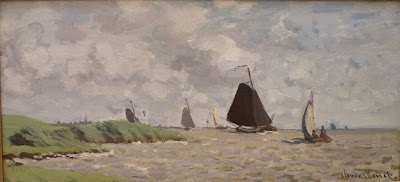
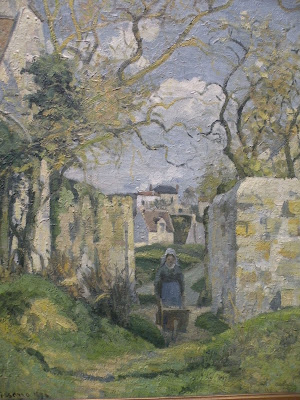
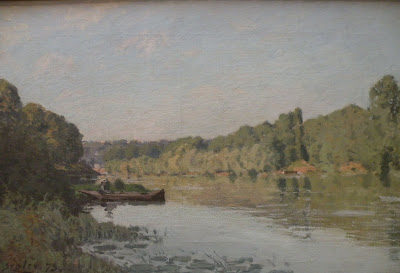
Impressionists at the National Museum
Monet's "From the mouth of Schelde"
Alfred Sisley's "Landscape from Bougivil", 1873Another famous impressionist master.
Adolphe Monticelli's "Party Strolling In Park With a Dog"
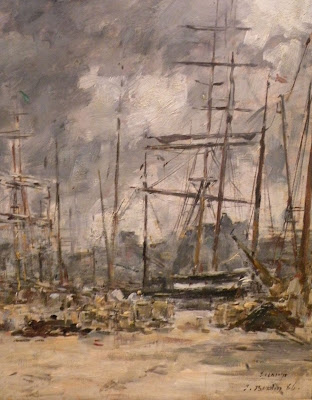
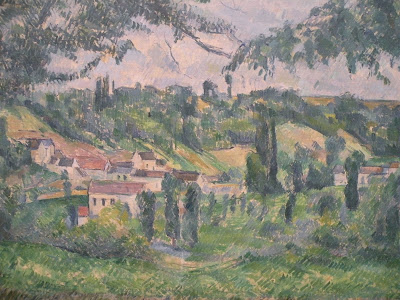
Paul Gauguin "landscape from arles", 1888Tuesday, March 10, 2009
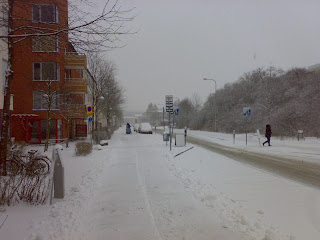
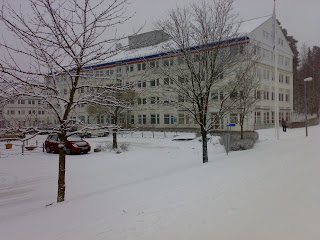
Inverse Holi
Near my apartment

Kista centre (nicknamed Chipsta because of the Tech Companies )
My office building
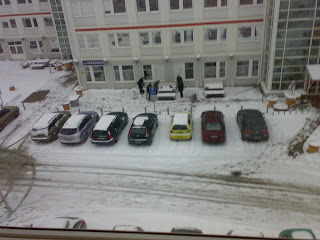
From my office window. Adobe Technologies building. Major major major... mentioned the purpose of windows seats in offices in japan. Thankfully this is not japan.
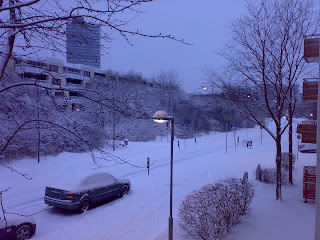
From the front window..
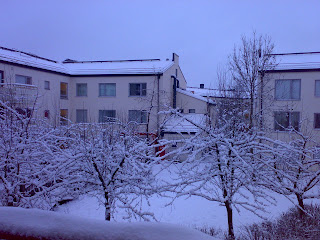
Someone made fun of me the last time I included the photograph of a backyard. I refuse to desist :-). Yes. Here is the backyard of the apartment :-)
Friday, March 06, 2009
Lalla's verses
First para is the English transliteration and second line is the the Devanagari generated at www.hindikalam.com. Third para has the English translation.
---------------------------------------------
1)
chhaan\thaan loosas paniy paanas
chhyapith gyaanas votum n kunchh
lay karmas t vochas althaanas
bari bari baan t chyavaan n koonh
छानठान लूसस पनिय पानस
छयपिथ गयानस वोतुम न कुनछ
लय करमस त वोचस अलथानस
बरि बरि बान त चयवान न कूनह
Searched myself, I, night and day,
Incomparable is the hidden way,
Finally reached the fountain of nectar sweet
Filled glasses everywhere but no drinker I meet.
2)
shey van cha\tith shashikal vozam
prakrath ha\nzam pavan seeat
loluki naar vaali\nji buzum
shak\nr lobum tamiy seeat
शेय वन चटिथ शशिकल वोज़म
परकरथ हंज़म पवन सीअत
लोलुकि नार वालिंजि बुज़ुम
शकंर लोबुम तमिय सीअत
Cut six forests and woke up the moon
Fought the wind and subdued it soon
Burnt my heart in love and held it alight
Then found Sankara in its glowing light
3)
Makaris zan mal cholum manas
aad mey labas zanas zaan
suh yali \thyu\thum nishi paanas
soruy suy t boh na kenh
मकरिस ज़न मल चोलुम मनस
आद मेय लबस ज़नस ज़ान
सुह यलि ठयुठुम निशि पानस
सोरुय सुय त बोह ना केनह
Cleared the dust of my mind
And myself did I finally see
When he came and sat nearby
He was all and who am me
4)
chaalun chhu vuzmal t tra\tay
chaalun chhu ma\ndinyan ga\tkaar
chaalun chhu panun paan ka\dun ghra\tay
hyet mali santoosh vati paanay
चालुन छु वुज़मल त त्रटय
चालुन छु मंदिनयन गटकार
चालुन छु पनुन पान कडुन घरटय
हयेत मलि सनतूश वति पानय
Thunder and lightening, if you bear
Moonless dark nights silently endure
Drag yourself through a grinding mill
Peace will come to you son, it surely will
---------------------------------------------
As usual, any suggestions/corrections are welcome.
Now for the dedication. Since this poultry, let the dedication be to the Muse herself. Let her never abandon us...
Sunday, February 01, 2009
Two Poems
The first one is from Master Zind(a) Koul, one of the mystic poets from Kashmir. The poems is in Kashmiri, so I wrote roman transliteration (line 2 of every stanza) and created the Devanagari (line 1 of every stanza) on http://www.hindikalam.com. I have also tried to do a more or less literal English translation (line 3 of every stanza). The idea was to convey the literal meaning only. I made little effort to keep any form of rhyme and none for the metre. Might try that another time. I am not really good at either Kashmiri (can hardly speak) or poetry, so any corrections/suggestions are welcome.
This poem is called Samran (Remembrance) and won the Sahitya Akademi award for the author. Here it goes.
1)
सुमिरन पनुन मेय दिचुनम लोलुक निशान वेसिये
रुचरुम तोगुम ना रोवुम औसोम ना बान वेसिया
Sumiran panun mey dichunam loluk nishaan vesiye
Ruchrum togum na rovum ausom na baan vesiya
He left me his remembrance, a sign of his love
I Lost it my dear, didn't have a safe place, a hidden cove
2)
पथ कलिये छुम ने दयुतमुत सवन मौखता दान वेसियेह
आयनेय सारेय कया लबख वयने तिम मौखता दान वेसियेह
Path kaliye chhum ne dyutmut swan maukhta daan vesiyeh
Aayney saarey kya labakh vayane tim maukhta daan vesiyeh
In times past, did I ever give, gold and pearls away
Poor blind me, how can I now see, where the pearls lay
3)
वैनेयिजि मैनज़े थोवुन घोचा, हावुन थोवुम अथस पयठ
रह कयुअसे छ कोर मेह पानस नौकसाना पान वेसियेह
Vaineyiji mainze thovun ghocha, haavun thovum athas pya\th
Rah kyuase chh kor meh paanas nauksaana paan vesiyeh
Should have hid deep it in the heart, where the secrets lay,
In a show of rich pride, put it on my palm, and gave it away
4)
हवुन छुह रावरावुन, छावुक समर छुह खैमि
थावन छ छावा बापत, बानन त ठान वेसियेह
Havun chhuh raavraavun, chhaavuk samar chhuh khaimi
Thaavan chh chhaava baapat, baanan t \thaan vesiyeh
To show is to lose, I know it now, what is precious you must hide,
The the dish is on boil, allow it to roil, but keep the lid tight.
5)
येने सुह निशान रोवुम, तेने मच गमिच चे फ़ुलवह
नयुन होन त कहन ति फ़ेरान छस वान वान वेसियेह
Yene suh nishaan rovum, tene mach gamich che fulvah
Nyun hon t kahn ti feraan chhas vaan vaan vesiyeh
The sign now lost, despondent me, I wander everywhere,
Asking the everysame thing, did you glimpse it, anywhere dear
6)
REPLY:
यछ पछ म हार बयाखा हयथ यूर वाति कँनछा
तस छा कमि निशनन, बयय बयय खज़ान वेसिये
Ychh pchh m haar byaakha hyath yoor vaati k\mnchha
Tas chha kami nishanan, byay byay khazaan vesiye
Don't lose hope Friend, someone brings it, I know it will be soon,
Does he lack signs, the giver of all treasures, under sun and moon
7)
ड़ोलान कोहन वनन मनज़ शोलन छ गुलशनन मनज़
जयोतन छ तारकन मनज़, कयतयह निशन वेसियेह
\Rholaan kohan vanan manz sholan chh gulshanan manz
Jyotan chh taarakan manz, kaytyah nishan vesiyeh
They wander in plains and fields, bloom in flowers, gardens and vines
They sparkle in the stars and planets, they are uncountable, the signs.
8)
वेसेरिथ देलिथ पथर पयथ बुथ कया दिमव तेमिस निश
पोथ फेरनिकि पकान छा यिथ ही बहान वेसियेह
Veserith delith pathar pyath buth kya dimav temis nish
Poth pherniki pakaan chha yith hee bahaan vesiyeh
You say, you lost your way, have broken down, how to show him your face
To turn back now, Is it the really fair, the excuse is not good enough
9)
मनव ज़ि आस हैवुमव पथ चोरया तसुनध मोहब्बत
पयवनध ये आदनुक चह शुरये दोसतान वेसियेह
Manav zi aas haevumav path chorya tasundh mohabbat
Pyavandh ye aadnuk chah shurye dostaan vesiyeh
Even if we turn back, can we lose his love, in this easy way
A bond unbreakable, the ground of our being, it is no childs play?
10)
दिल फुटयमतयन छु तोशन, यच गरिमतयन छु रोशन,
गछि वेरिमतयन सुदामन, परछ गायिबान वेसियेह
Dil phu\tymatyn chhu toshan, yach garimatyan chhu roshan,
Gachhi verimatyan sudaaman, prachh gaayibaan vesiyeh
He is the healer of broken heart, and the tamer of the proud mind
If you don't trust me, ask sudaama, or some true lover you find.
11)
आनध पख तति छु आसन बवध बरोर सुरदासुन
बोज़ान छुह माय लेगिथ लोलुकै तरान वेसियेह
Aandh pakh tati chhu aasan bvadh bror surdaasun
Bozaan chhuh maay legith lolukai taraan vesiyeh
Everpresent, invisible, the playful child of surdas, wanders about and above.
With great joy and merriment, hears these songs, sung of love.
I don't think there are any copyright issues in posting the orignal, but in case you feel there are please let me know
The second one is a Pakistani poet by name of Kateel Shafai. Found the poem on the website www.kavitakosh.org. Among Pakistani peots I personally like Faiz Ahmed Faiz the most. Discovered Kateel only a couple of weeks back and liked his use of simple language. Here is the poem and the translation by yours truly. Tried to keep as close the original literal meaning as possible, without sounding too awkward
पहले तो अपने दिल की रज़ा जान जाइये
फिर जो निगाह-ए-यार कहे मान जाइये
First learn you must, of your hearts way
then do as the beloved's eyes do say,
पहले मिज़ाज-ए-राहगुज़र जान जाइये
फिर गर्द-ए-राह जो भी कहे मान जाइये
First know where the travellers mood may be
Then accept what the road's dust decree.
कुछ कह रही है आपके सीने की धड़कने
मेरी सुनें तो दिल का कहा मान जाइये
Something my dear, your heartbeats whispered now
If you may heed my suggestion, do follow it love
इक धूप सी जमी है निगाहों के आस पास
ये आप हैं तो आप पे क़ुर्बान जाइये
The sun is blinding my eyes, I guess,
Or is it you, the one I want to bless.
शायद हुज़ूर से कोई निस्बत हमें भी हो
आँखों में झाँक कर हमें पहचान जाइये
I wonder if your friend I may possibly be.
Look deeply in my eyes and recognize me
Now comes the customary homage to Colonel. For Colonel poetry is pronounced (and also written and thought and cooked and devoured and ...) as poultry. Those two words are equivalent entities (isomorphisms to use the mathematical term) in his dictionary. And though poetry can have fairly interesting mathematical structure in metre and rhyming, I have for some reason been unable to evince his interest towards its non-avian properties. And though I like chicken, I am not all that fond of those birds to waste a couple of hours on it. So my interest or inspiration (or perversion if you may like to call that) comes from elsewhere. Who or what that may be will have to wait for some other day...
Thursday, October 09, 2008
On nature of Kitsch
If Art is the representation of life in its widest sense, kitsch is the representation of the concepts about life. And even using the word "concepts" is not enough. I would have to qualify it. Conceptualization itself is inherent in all art. But in true art, conceptualization is "in the moment", and ephemeral. It is also highly individual. That is why for a body of work of single artist, it also evolutionary with time. For kitsch on the other hand, the very same "concept" is folklore. The concepts of beauty inherent in all art is not felt and lived, but only taken from culture, tradition or pre-formed ideals (or memes). The appreciation and enjoyment is also superficial. It is, because it has to be. Since it is static and forced, even if unconsciously.
The worst enemy of art and individuality of creation are the stranglehold of cultural habits and conditioning. Only by getting rid of this, can one form appreciation and feeling for that which is highly individual. Such appreciation leaps across times and cultures, though not fully. The last part is due to inherent tie between language and technique of art and the time and culture associated with it. Kitsch is art generated from time and Culture, without any individuality and true sense of beauty.
As for Colonel, all that is written above must be an exercise in foolishness. Since for him, in light of his immense wisdon, knignts and cardboards, beauty and truth, kitch and otherwise, may all appear useless concepts. The only thing worth considering, perhaps, are equations. Or maybe not even those...
Saturday, July 21, 2007
The MQ Factor
==== Disclaimer Starts ====
No offence intended.... No benefits promised.
==== Disclaimers Ends ====
==== Advertisment Starts ====
So what is MQ factor. MQ factor will tell you more
about yourself than a lifetime of pschoanalysis by
Freud himself. MQ factor is the essense of your
being. Much like relativity, it may seem flippant at
first but it is profound, which only sincere effort to
understand will reveal. "M" of course is the sacred
syllable. Don't ask me what it stands for. Think of it
as YHWH Release 2.0. Only to be revered, never to be
spoken. Those who know about it, know about it. And
those who don't, can't be told. But if you insist,
here is the invocation to start with...
The sacred "M",
The source of all,
Padmasambhava's gem
Our destinies call.
For knowing our worth
This quiz we take
To our sorrow and mirth
Do we solemnly awake.
"Q" is of course the much more mundane oxford
dictionary "quotient". Whatever has got left of you
(and me) after getting sufficiently divided. It is
designed to correctly estimate your potential (
knowing whether you ever realize your potential is
tougher to tell, and may need solving NP problems). It
is exact. It tells you about all your past and future.
It is deterministic. And whatever MQ factor you will
get eventually, is unalterable even by gods (if and
when they start proving their existance ). Amen.
==== Advertisment Ends ====
==== Quiz Starts ======
Answer these questions and thou shalt learn thy
destiny:
1) Number of pens found in your shirtpocket (or purse
for ladies)
a) What is a pen used for??
b) 1
c) 2 or 3
d) 4 or above
2) Which colour of pens do you keep (as you will see
colour is the most important property of the universe.
Most other things "pale" in comparison).
a) does not apply (see above)
b) Blue or Black
c) 2 to 3 colours
d) >= 4 colours (I always remember the
four-colour theorem!)
3) What is the type of your handwriting
a) What is "writing". I am still in the stone
age. (Or too far off in foundation's intergalactic
empire.)
b) I love scribbling and scrawling. Don't care
if anyone understands or not. Or even I do.
c) Discipherable, though ugly.
d) Human Typewritter. (Or a computer font, for
variety)
4) Number/Type of underlines used used while writing
a) None
b) One
c) Multiple but same throughout.
d) Multiple and different depending on type of
heading/text.
5) Rough work
a) Don't do any rough work at all. It is too much
effort to move the fingers. Thinking (and snoozing) is
easier.
b) Do some. Mostly on the sand (with sticks) or
on napkins.
c) Do in a properly designated pad. New page each
time.
d) Use multiple colours and multiple underlines
even for rough work.
6) Number of Writing Pads used
a) Stone age, remember!
b) One. If I find it when I need it, which is
usually quite rare.
c) One and I stick to it till the last page runs
out.
d) Many, one for each type of task. An additional
one for personal todo list.
7) Documentation Software Used
a) Notepad or Vim (even drawings are done in ascii
art)
b) Latex (the only true one).
c) Word
d) Only Excel or Powerpoint
8) Average Length of folder & file names I use on my
PC.
a) 2
b) 5
c) 10
d) > 20
9) Habit of colliding with people/lampposts.
a) My office coffee bill (and laundry bill of my
coleagues) is doubled due my uncontrollable dynamics.
(Though I always find equations for blocks sliding
down an inclined plane easy.).
b) Run only into CEOs or Presidents of my company.
Great scientists or aritists also make the grade,
whenever available. Lesser mortals are obviously
excluded.
c) Rarely. And that too when in a hurry. Don't care
about who suffers. A true democrat.
d) Never. What are eyes for.
10) The difficulty level of your work.
a) All work is difficult. Better sleep.
b) It is always easy. But there is nothing else to
do.
c) It is always easy but I can always be found
slogging.
d) It is always difficult but it gets only done due
to my greatness and hardwork.
==== Quiz Ends ====
==== Rating 1 Starts =====
Assign the following points for each of the answers
a) 0 (always start indexing by 0, except in the
accursed matlab).
b) 1
c) 2
d) 10
Add them up to get your MQ factor. You might need the
calculator depending on your hair type (pointy or
not).
And here is the rating.
A) Between 0 and 4 :
Fully Englightened. You are a Living buddha. O
Maitreya, I bow to thee. Suffering is beyond you.
B) Between 5 and 9:
Fool. Wake-up. Light of wisdom has still not fallen on
thy mortal soul.
C) Between 10 and 50:
You are going to go a long way. Your represent the
most important thing in statistics. The first order
moment rather than the second. Most of the time not a
very bad situation to be in these matters.
D) Greater than 50
You are the ineffable Perfection. You are the
singularity of the Big Bang! If you don't become the
PA, you will become the President. God save..... the
rest of us :-)
==== Rating 1 Ends ====
==== Exhortation Starts =====
Do share your score,
If you don't mind
Will share mine and more,
and pay in kind.
==== Exhortation Ends =====
This quiz was specifically designed keeping two people in mind to form the two opposite polarities. One of them is obviously Colonel. Anyway, that is how I get to make my mandatory dedication to Colonel for this post.
Tuesday, June 05, 2007
Music : Patterns in Time and Frequency - Part One
So that leaves us with a bewildering variety of musical styles and compositions, each unique, and almost intellectually unanalyzable. Hence the need for classification. But is there an existing structure to all music which can help us classify, categorise and identify different types of music and hence makes the patterns intellectually visible? Yes indeed, a zillion types of classifications are possible, but the classification used has to satisfy the criteria of helping us in identification the essence (for want of better word) of a musical piece, matching our innate verbal descriptions, if possible. There are many types of classifications, modality, rhythm, genre, origin, etc. Here I plan to write down about modes, scales and the related though distinct concept of Raga in. I plan to discuss Indian musical traditions and their relation with Western Classical and related traditions, party because I have some familiarity with those forms, and partly because those are probably some of the most well defined forms which uses these set of classifications extensively. Later I plan to also add articles about specific Ragas and related Scales.
Notes : Natural and Sharps/Flats
Firstly let us review the well-known basics. Let us start from notes. As is well known, there are a total of seven natural notes in the scale. These correspond thswara(or sur) in the Indian system. The usual denotation of these notes in western musical system is C D E F G A B. Now that is a pretty colourless nomenclature, so the southern Europeans also tend to use the solfege system of denotation. Now the notes become Do Re Me Fa So La Ti. The solfege is pretty uncommon for Indian teachers of western music. We tend to follow mostly the alphabetical notation, probably again borrowing from the British as in other things. The corresponding swaras in Indian system are 'Sa Re Ga Ma Pa Da Ni Sa'. Each of these is a short form for a Sanskrit word i.e. 'Shadaja Rishab etc'. As is evident, the Ancient Indians were quite imaginative when it came to naming. Most people translating Indian texts (especially the Chinese and Japanese Buddhists), find Indians writers too abstract and symbolic to their liking. But that is how things are. How to explain it is beyond my ken. Anyway coming back to our story, the above 7 list isn't the complete list of notes. In fact there are notes lying in-between the natural notes. These are denoted by adding a Sharp or Flat before the corresponding natural note names, depending on whether it comes before or after the natural note. For example the note lying between "C" and "D" can be called a "C Sharp" or a "D Flat" note. That is, "C Sharp" and "D Flat" denote the same note, the one lying between C and D. So we should have a total of 14 notes, including Sharps (or Flats). But that is not the case. There are no notes between B and C and also between E and F. So we have only 12 possible notes. It should be notices that I have used the term "natural notes" and "notes" for 7 cardinality set and 12 cardinality set respectively. The natural notes correspond to the "White Keys" on a Piano or Synthesizer or Harmonium. The "Black Keys" are the Sharp (or flat) notes. So there are always a total of 5 "black keys" for each set of 7 "white keys". In Standard notation C Sharp may be denoted as C# and C flat as Cb. The corresponding terms for sharp and flat in Hindustani Classical system are Tivra and Komal (literally sharp and soft).
An aside on the physical properties of notes.
The notes of the octave are plotted on a logarithmic frequency scale. we will get a plot of notes which are at equal distances to each other. Hence this kind of scale is called a equitempered scale. To summarize the notes are equidistant on a logarithmic scale. Notice that we are talking about the 12 numbered set of notes and not only the natural notes. Only by including the sharps and flats can we get a equal-tempered scale.
Octaves
Now the set of 12 notes form an octave. If we go further up or down the frequency scale we will find the same set of notes in the higher or lower octaves. Depending on the instrument, we have 3 to 4 possible octaves. Each of these octaves has a unique set of 7 notes plus the sharp and flat notes. for example if a piano has 4 complete octaves, then we have total of 4x12=48 keys. The 6 string guitars have around 4 octaves. The human voice is considered have 2 to 3 octaves. Females usually have high pitched voices compared to Males so they tend to use higher octaves.
Another aside on the physical properties of octaves
The Frequency of one octave to next is related by a factor of 2. Hence if the first octave is considered to be at 440 Hz, the second octave will be at 880 Hz, the third octave will be at 1760 Hz and so on. Notice the logarithmic progression. the Third octave is not 3 times the first octave. It is 4 times. So the next octave will be 8 times the first one.
In fact if the standard A is considered to be 440Hz (as done in current western music), any other note frequency can be calculated by finding the distance of the note from standard A. Here the A is <<>>
Scales
Scales can be considered a method of enforcing discipline on which notes to play for a particular composition. Simplistically, scale is the subset of the 12 possible notes. This subset can have any number of notes, though those having 7 or 5 are the most common. Though some compositions may change scales midway, or use multiplicity of scales, again for simplicity we may consider that a scale remains unchanged in a composition. By sticking to a scale a musical composer can give a free rein to his/her imagination and still stick to a theme or pattern he/she chose, or a performer can improvise during performance and still reduce possibility of moving into to jarring musical territory. A particular scale ( and mode) tend to signify a particular human feeling in all music traditions. Though it may sound amazing, the effect of a scale considered and defined in one culture tends to be the same across all cultures. So a scale may be linked to cheerfulness, another to seriousness, and yet another to gloom. Again Ancient Indians, bent upon their classifying and enumerating ways, defined 9 rasas each corresponding to one human emotion. All ragas (Indian classical scales), correspond to a particular rasa. Even in Western tradition, different scales are generally ascribed to different human feelings. So Major scale is usually considered for celebratory and cheerful songs, while Minor scale is used for songs in more sombre mood. Let us take an example of "C Major" scale. For this scale we will use 7 out of the 12 available notes. These notes can be played in any order on on any octave (remembering that the same notes will also be available on many octaves). For "C Major" scale these 7 notes happen to be the natural notes as discussed above namely C D E F G A B C. Notice that we start from the note C for describing the scale. This note "C" is the root note for the "C Major scale. Now predictably "C Major" is almost the first scale taught in music. The raga corresponding to the same scale in Hindustani Classical is Bilawal. This raga is also very commonly taught as the first raga, along with Yamen (another popular raga). Taking another example the "C minor" scale corresponds to the notes "C D D# F G G# A# B". Here the # sign has been used to denote the sharp notes as is the common in notation. The main thing to notice is that even though here too we have 7 notes only, the set of notes is different. The root note is still the same "C" note, and the importance of root note will become clear as we move further into modal territory.
Modes
As evident from the examples above, a scale is fully described by a two parametrises. The first is the root note as discussed. The second, still unexplored, is the mode. First two new terms: tone and semitone. A tone is defined as a distance of two in a equitempered 12-note system. A semitone is defined as distance of one in this equitempered metric. So next semitone after 'C' is 'C#', but the next tone after 'C' is 'D'. Again, next semitone after 'B' is 'C', but next tone of 'B' is 'C#' (because B doesn't have a sharp note). Now considering the same example of "C Major" scale again, we see that the set of notes "C D E F G A B" which constitute the scale are a distance of "T T S T T T S", if we denote tone by T and semitone by S. This set of distances is in fact the essence of the Major Mode. So if we select a different root node, instead of 'C' selected above, and keep the same tone/semitone distances, we will have another scale of Major Mode. Now considering the same example of "C Major" scale again, we see that the set of notes "C D E F G A B" which constitute the scale are a distance of "T T S T T T S", if we denote tone by T and semitone by S. This set of distances is in fact the essence of the Major Mode. So if we select a different root note, instead of 'C' selected above, and keep the same tone/semitone distances, we will have another scale of Major Mode. So if we select 'D' as the root note and try to find the other notes in "D Major", we just write down the 12 notes and selected distances for Major Mode, starting from 'D'. So the set of notes is
A A# B C C# D D# E F F# G G#
and writing the distance from D
7 9 11 0 2 4 5
We can remember that "T T S T T T S" turns out to be "0 2 4 5 7 9 11" if T is replaced by "2" and S by "1" and series is cumulatively added. Hence using this distance property scale for any root note can be created only by knowing the modal properties.
There are many modes in Western Music, the most popular ones being Major (or Ionian), Minor Aeolian) modes.
Thaats & Ragas
Thaat, more or less, is the Hindustani classical music version of Mode in western music. It identifies the number of notes and distance properties and selecting any root note, we get different scales. But again, there is no concept of Scale in Hindustani Classical music. What we have instead is Raga (or Raag). Though related, Raga is much more specialized entity compared to a scale. The discipline for composition is much more stringent, hence compositions in same raga are much more similar compared to compositions in same scale. The raga not only defines the notes to be used but also the order and frequency of the notes. The defining characterstics of the Ragas are:
Aaroha : The set of notes to be used while going up the scale.
Avroha : The set of notes while going down the scale.
Vadi : The most important (or frequent) note.
Samvadi: Second most frequent note.
Pakad: Usually a musical phrase common to the raga.
There may be additional attributes defined for ragas like time of day to be sung etc, but those are anyway besides the point of what we are discussing here i.e. patterns. Besides all the above, one more unique characteristic of the system is that even the notes nominally assigned for the raga characteristics do not follow the exact equitempered scale properties as defined above. In fact Hindustani classical form doesn't even recognise equaltemperedness of notes. The notes can be shifted up and down all along the vacant area between the equal-tempered points. We have entered micro-tonal territory now. These micro-tonal notes can not be played on most western instruments like piano or any other keyboard instruments. Most strings instruments and especially non-fretted instruments allow micro-tonal playing. All Indian instruments allow micro-tonal playing.
Composition and Structure
Besides the tonal disciplines, musical forms can be classified based on the polyphonic structure. Polyphony is when multiple melodies can be played together at the same time. In contrast monophonic music incorporates only one melody at a time. Polyphonic music can not be performed by a lone musician, and is usually part of elaborate orchestras. Some forms of music incorporate some polyphonic characteristics while being inherently monophonic. Most rock and western popular music is mostly monophonic but incorporates polyphonic characteristics by invoking independent chord accompaniment to the main melody being played. Similarly Hindustani Classical forms are mostly monophonic but have drone accompaniment in form of strings instrument like tanpura playing independently.Even in the polyphonic structure case, the scale and mode characteristicsare usually stuck to.
.....INCOMPLETE..........
Sunday, September 10, 2006
Belief
Monday, September 04, 2006
Totally harmless
Friday, August 18, 2006
Lost Tribes of "Somewhere Else"
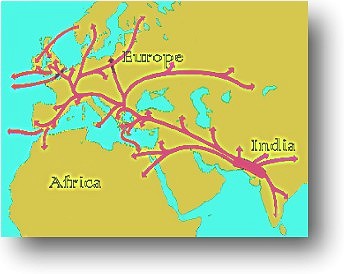
Gypsy is a word derived from Egyptian. These people were nomads who first started entering Europe during the Middle Ages (circa 1500) and were thought of by the Europeans to be have come from Egypt. The word Egyptians degenerated into Gypsies with the passage of time as the tribes spread far and wide into every corner of Europe. However they failed to get fully assimilated into the local populace due to their different cultural and religious habits, not to mention their physical distinctness. They were generally thought to have come from Egypt, and in time they too came to believe it.
Whatever the exact details, today most Gypsies are spread all over the world and they identify themselves as Romani's or Roma's. The history of gypsies is surely one of the most facinating accounts of intercontinental migration by entire tribe known to have occured in modern times. It is perhaps only comparable with the similar migration of Turkish people during middle ages starting from Central Asia, all across Asia, to form the modern day Turkey. That will perhaps be another good story...